Summary





Virtual Try-On: The Next Revolution in E-Commerce

Published on 6/1/2026 by Hugo Rimélé
Originally published by Yahong Zhang, fully rewritten and updated by Hugo Rimelé "Co-founder and specialist in emerging technologies and digital transformation" on June 1, 2026.
57% of consumers want to see, touch and feel items before they buy them. EY Future Consumer Index, 2024
➜ Explore Fred’s 3D jewelry configurator with bracelet Virtual Try-On
That single stat captures the core friction of online retail, shoppers can’t handle a product before they buy it. For an e-commerce or digital director, that friction shows up very concretely hesitation at checkout, abandoned carts, and costly product returns. Virtual Try-On (VTO) tackles this head-on by letting the customer try a product, on themselves or in their space, straight from a smartphone. In this article, we’ll look at how VTO helps brands deliver a reassuring, high-impact omnichannel shopping experience, where the technology stands today, and how leading brands are positioning themselves around these innovations.
Why Virtual Try-On Has Become a Strategic Priority
VTO addresses one of the leading causes of online dissatisfaction: not being able to see an item or garment clearly. For customers, that creates doubt, friction, and frustration. For brands, it translates into high return costs and e-commerce performance dragged down by purchase-decision uncertainty. The stakes are enormous: returns alone account for roughly $740 billion in global e-commerce. By reducing pre-purchase uncertainty, VTO acts directly on that cost line. It also unlocks online sales of high-value SKUs fine jewelry, watches and anchors the experience within an omnichannel strategy.
The desire to try before buying runs deep: according to research reported by Retail Dive, nearly 9 in 10 European shoppers still favor the physical store precisely so they can see, touch, and try. The opportunity for brands isn’t to pit physical against digital, but to bridge the two in an omnichannel approach that lifts sales.
That’s exactly what our virtual try-on technology enables: turning passive browsing into an active, reassuring interaction across every channel.
What is Virtual Try-On?
Virtual try-on technology enables customers to try on products directly from their camera-equipped devices, like smartphones.
➜ Talk to us about your digital transformation
Market Momentum and Growth Outlook
The virtual commerce space Virtual Try-On and 3D visualization is accelerating at an unprecedented pace. The latest projections point to a 22.9% compound annual growth rate over the coming decade. Valued at just over $4 billion in 2024, the market is expected to cross $32.7 billion by 2034, confirming mass adoption by the world’s leading retailers. Source : Global Insight Services
The “Digital Twin” Becomes the Retail Standard
The shift to all-digital is no longer about displaying simple photos. Every product and soon every customer will have a digital clone, opening the door to entirely new use cases. Everything will be represented in a virtual twin. Jensen Huang, CEO of NVIDIA
This shift, already underway, makes it possible to create immersive experiences that render virtual try-on as natural as trying on in-store. Source : https://blogs.nvidia.com/blog/huang-3dexperience-2026/
Customer Experience as the Top Priority
Beyond the technical feat, it’s the customer experience that matters most. The goal: make buying easier and reduce uncertainty. Available across channels, digital products turn passive browsing into active, reassuring interaction and a strong experience also strengthens brand image.
"92% of respondents favor shopping in physical stores. This mostly is because they can see, touch and try. <...> Clearly consumers are demanding both physical and digital – and brands and retailers have a chance to bridge the gap and create a joined-up omnichannel approach that boosts sales."* *source: Retaildive
The Major Technology Trends in VTO
The Revolution in Online Apparel Try-On
TryOnDiffusion, a Google technology, uses image diffusion to project a garment standalone or worn onto a photo of another model, preserving pose, detail, and composition. Players such as DressX apply this kind of approach to simulate realistic fabric rendering. These AI solutions deliver excellent results exactly where 3D has historically struggled: on a mannequin, 3D garments often looked rigid and fabrics unconvincing.
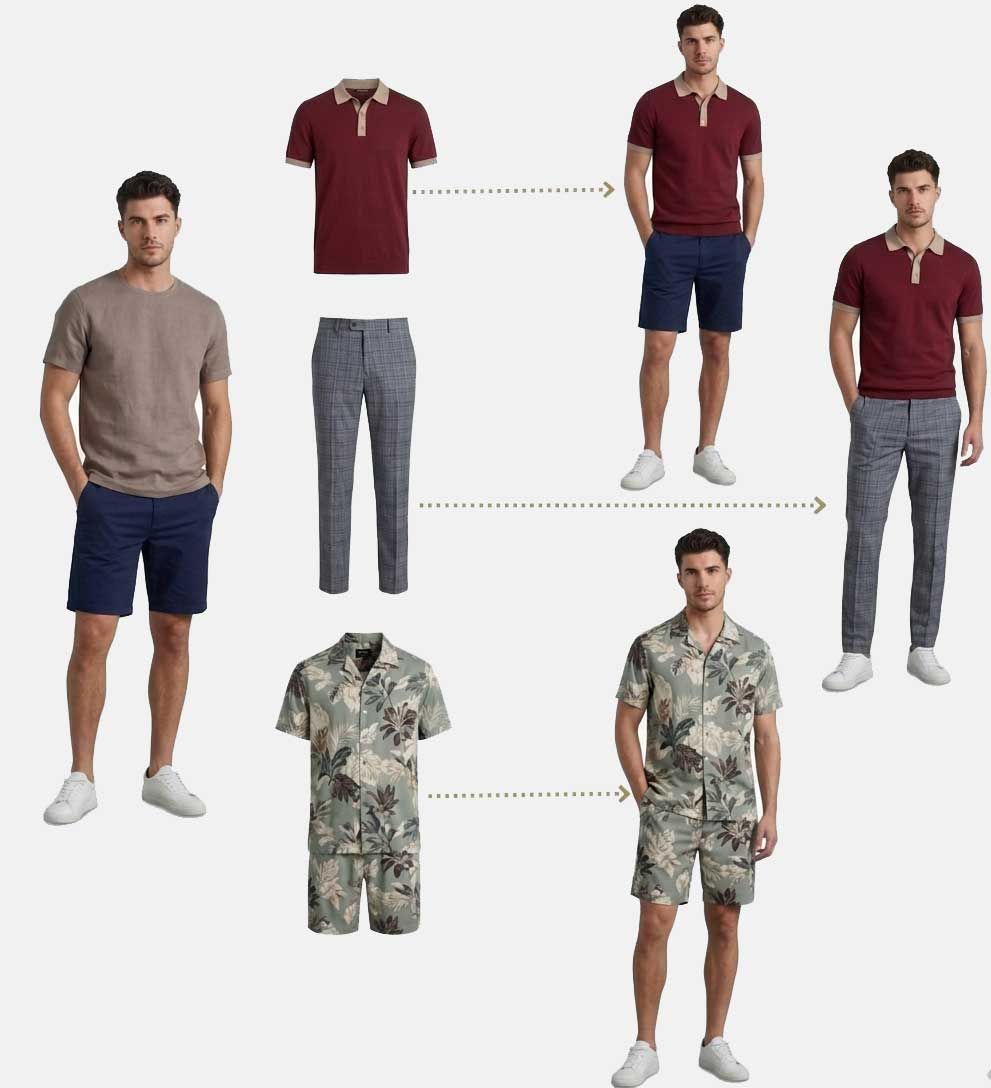 AI-powered virtual try-on of apparel technology
Google’s Virtual Try-On API lets shoppers see how clothes fit and move on their own body with striking accuracy. Built into the Gemini Enterprise Agent platform, it is rolling out across the U.S. and Europe for Diesel and Jil Sander, before expanding to Marni and Maison Margiela. VTO obviously isn’t limited to apparel. One principle holds across the board: the experience must be as simple as possible. For a try-on to succeed, the user should have nothing complicated to do just pick up the phone and try the product, at home or on themselves. Some sectors adopted it early. Eyewear was a pioneer: virtual glasses try-on has existed for years, because 3D face tracking has long been mature. Algorithms lock onto well-defined points (eyes, nose, lips), making face tracking robust and fluid. The same family of tracking powers another early mover virtual makeup.
From Face to Body: Increasingly Sophisticated Tracking
To work on other parts of the body, VTO algorithms require far deeper expertise and rely on deep learning.
Why Wrist and Hand Tracking Remains the Ultimate Challenge
Hands and wrists demand far more complex algorithms: the anchor points are much less clearly defined. The challenge is to be both precise and functional on the vast majority of smartphones in use today. Machine learning now delivers excellent results. The principle: train an algorithm on a very large number of images so it can recognize and position a 3D object across most real-world scenarios. At Hapticmedia, our team of engineers and mathematicians has developed several algorithms that accurately detect the position of an arm in space, under most lighting conditions. To get there, the algorithm has to learn a vast range of situations and lighting conditions. We built our own system to simplify and speed up that training and to reach a very high level of quality.
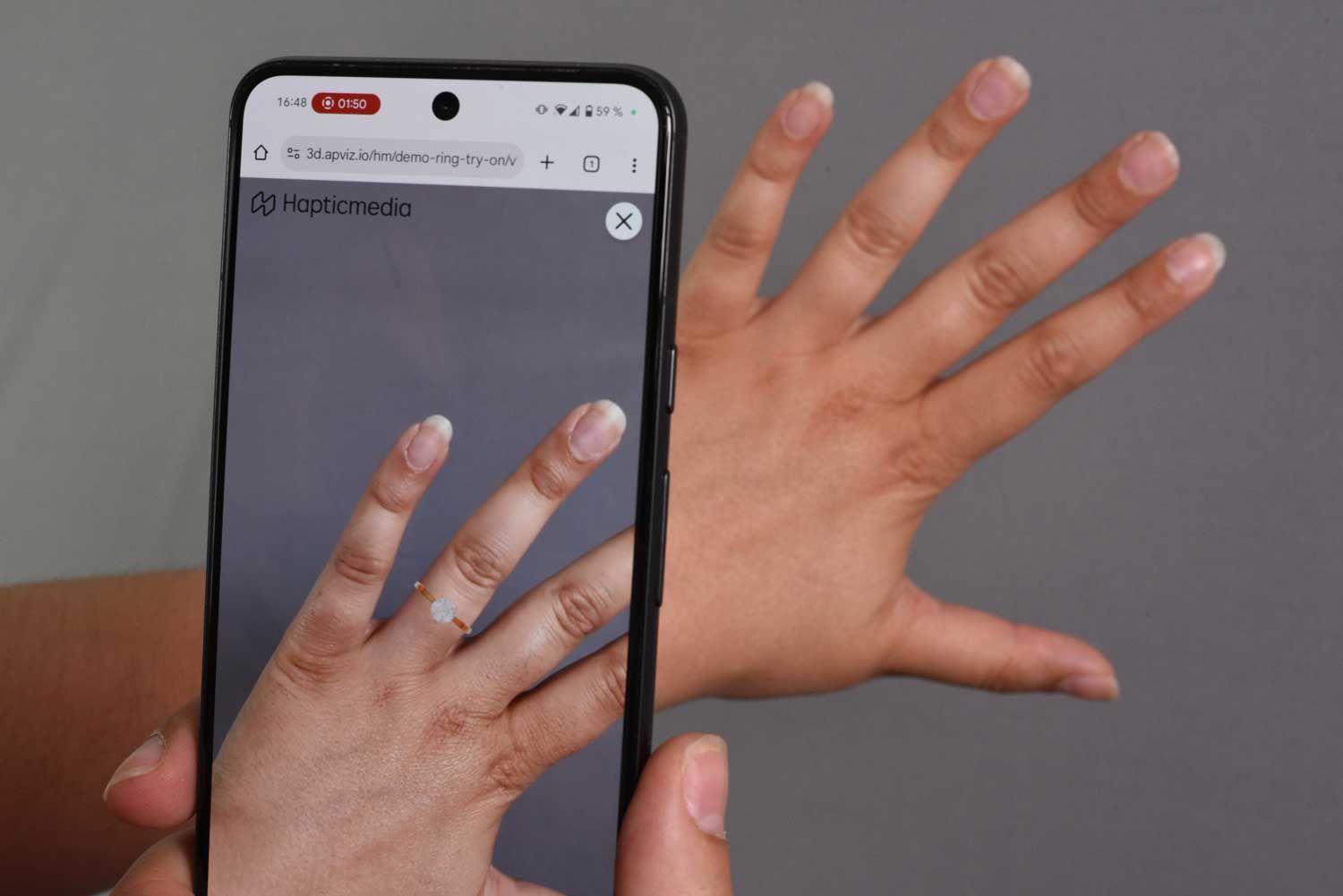 Hapticmedia solution (real-time virtual try-on)
Precision and 3D Render Quality: The Key to the Experience
To be believable, a VTO needs excellent motion tracking, but it must also adapt to ambient lighting to present a coherent, harmonious 3D object. The quality of the 3D materials is just as decisive. The Hapticmedia approach is built on bespoke quality and high fidelity. We handle the complexity of customizable jewelry, luxury watchmaking, and gemstone rendering with a High-Fidelity, Web-Native AR solution that features photorealistic, true-to-life 3D materials. Who can picture themselves making a high-end purchase if the object on screen lacks visual quality? The experience has to be credible and immersive because without high-quality rendering, the user simply won’t buy..
That’s why Hapticmedia also offers an in-store virtual try-on kiosk, delivering a hyper-realistic, precise experience that helps confirm sizing. It lets customers try products or colorways that aren’t in stock and it pairs naturally with online VTO (using the same 3D assets) for a true multichannel experience.
Generative AI or 3D Virtual Try-On?
Generative AI remains a rapidly expanding technology in the digital landscape. The premise is straightforward: by combining product imagery with photos or videos of models or clients, AI generates customized "as-worn" visuals. While the aesthetic results are compelling, this method lacks the real-time, immersive engagement that allows clients to move freely and view products dynamically. However, it does enable the visualization of almost any product category, simply and cost-effectively. While both technological families leverage artificial intelligence, 3D Virtual Try-On (VTO), which projects digital twins via the user's device camera delivers a significantly more sophisticated, high-end experience.
The table below summarizes the key trade-offs:
| Criterion | Generative-AI VTO | 3D VTO (real time) |
|---|---|---|
| How it works | Projects a product image onto a customer photo / video. Generates custom “worn” visuals. | Projects a 3D clone of the product through the camera; the customer truly tries it on in real time. |
| Strengths | No 3D model to produce. Fast to deploy. Ideal for generating visual content at scale. | Immersive, high-impact experience. Try-on in motion, on yourself. Web + in-store consistency. |
| Limits | Risk of AI hallucinations. Limited to images and video. No real-time immersive try-on. | Requires 3D assets (increasingly AI-generated). Depends on the environment. Premium-oriented. |
| Best-fit products | Apparel, footwear, jewelry, watches, eyewear, hats. | Eyewear, footwear, jewelry, watches. |
| Experience | Visualization on image or video (Veo, Sora style). | Immersive, interactive, real-time try-on. |
Why Choose Hapticmedia?
For high-end products, brands won’t settle for standardized or simplified visuals. Hapticmedia helps clients deliver immersive, high-quality experiences that closely match their expectations for brand image and customer experience.
In-Store VTO: A True Omnichannel Experience
Virtual Try-On (VTO) is no longer confined to online channels or social media; it is equally valuable in-store, seamlessly bridging the gap between digital platforms and physical boutiques. Increasingly integrated into brick-and-mortar locations via connected mirrors, VTO effectively compensates for limited physical inventory.
On-site, it allows clients to virtually try on products or sizes unavailable in the showroom such as a timepiece in a specific finish or dimensions not currently on display. It empowers customers to explore endless combinations of materials, colors, and custom engravings, driving a true mass customization experience. Most importantly, it secures the sale on the spot, allowing clients to confidently order bespoke or made-to-order creations.
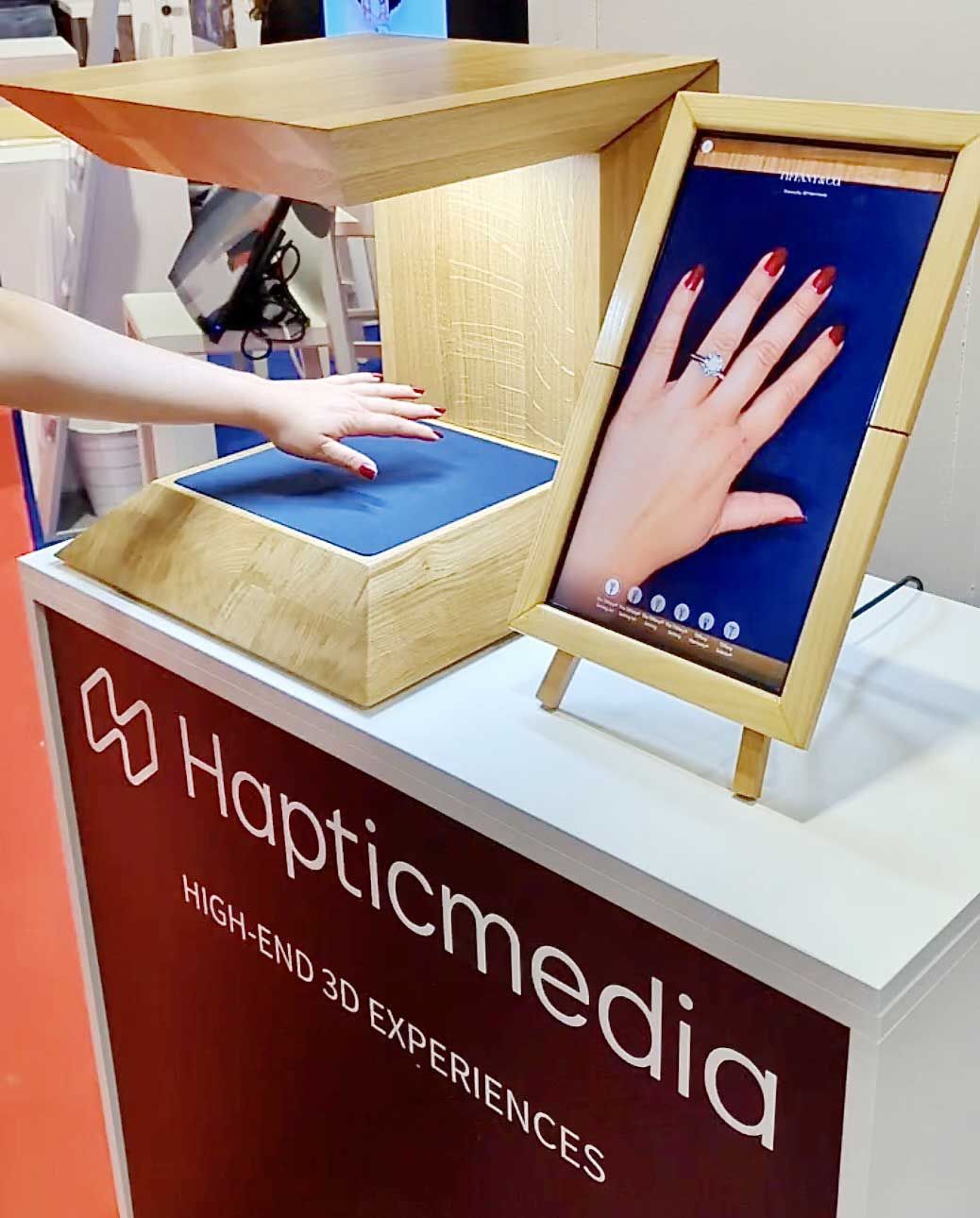 Jewelry VTO in-store solution
The Right Product in the Right Size
For ring try-on, our system estimates finger size with accuracy. In-store virtual try-on of rings and watches also delivers highly precise tracking, since lighting and environment are fully controlled.
Brands Already Betting on These Technologies
Chanel offers virtual try-on across a wide range of products: makeup, eyewear, jewelry, and watches can all be tried on virtually. Cartier also lets customers try a large part of its collections via VTO directly on its site: a dedicated section provides online try-on for a selection of its watches and jewelry. Jeweler Fred now offers a virtual try-on feature directly from the 3D configurator of its iconic Force 10 bracelet. How does it work? Design your custom bracelet, scan the QR code on the e-commerce site, and instantly try it on using your smartphone.
Conclusion
Virtual Try-On (VTO) is rapidly becoming the benchmark for industry-leading brands, solving critical operational challenges while elevating both product perception and brand equity. As a fully integrated omnichannel asset, it seamlessly unifies digital storefronts, social platforms, and the brick-and-mortar retail experience. Driven by the proliferation of powerful smartphones and ultra-precise motion tracking, this technology now delivers unprecedented realism. Simultaneously, the evolution of Generative AI and automated 3D modeling is streamlining asset production pipelines. By significantly lowering production costs, these technological advancements are accelerating the adoption of an experience that is fast becoming the industry norm.
Explore next
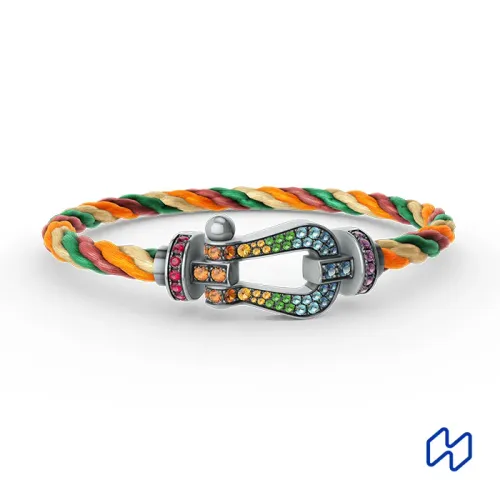
Fred
We elevated Fred's e-commerce with a 3D configurator and AR virtual try-on for their iconic bracelet, driving conversions and brand innovation.
Learn more
AR in ecommerce
Bridge the gap between digital and physical. Our AR & VTO let customers try products in their space or on themselves to drive confident purchases.
Learn more
Future of Retail: Future is Phygital
Learn more